
Flowers have always held an important symbolic role in art, literature, and of course, film.
They are often used as a visual shorthand for themes of romance, passion, innocence, frailty, joy and even loss, adding layers of meaning to a story without saying anything at all. Flowers offer rich symbolism, with each representing something different. Roses are for love. Lilies are for innocence. And lotuses are for rebirth. Some characters hold specific flowers that say something about them.
From the famous rose petals in the bathtub scene from American Beauty (1999) to Dorothy amongst the technicolour poppies in The Wizard of Oz (1939), their use can leave a lasting impression. Here, we bring you the 10 best floral moments in film.
Sex and the City Movie, 2008
One of the most seminal events in the Sex and the City universe was undoubtedly when the perennial single girl, Carrie Bradshaw, was dumped at the altar on her wedding day by Mr Big. The scene is unforgettable, from Carrie’s breathtaking Vivienne Westwood wedding dress, to her bouquet of cream, yellow and white roses and gardenias being used to hit her jilting beau in the face as she shouts, “I knew you’d do this!” There’s a close up of the petals scattering on the flour as the bouquet practically explodes, with Carrie’s friends all dragging her away (and Charlotte visibly upset at the flower destruction). In choosing her bouquet as her weapon, she is turning the symbol of her promised happiness as a way instead of showing her rage and humiliation, and ultimately, their broken connection and her crushed dreams.
American Beauty, 1999
Roses play an integral part in 1999’s American Beauty. In fact, many have probably forgotten that it’s where the name of the title comes from – the ‘American Beauty’ variety of rose that Carolyn Burnham (Annette Benning) grows in her picture-perfect garden. Lester Burnham (Kevin Spacey) frequently imagines his daughter’s friend, Angela, who he has developed an obsession with, bathing in rose petals, in what have become some of the film’s most memorable scenes. At its heart, the rose symbolises the beautiful facade of suburban life, with the spiky thorns that lie underneath always ready to stab you.
Big Fish, 2004
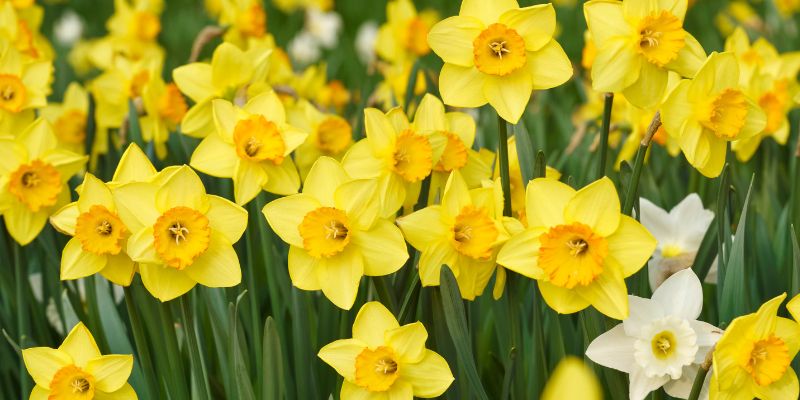
There are plenty of memorable scenes in 2004’s Big Fish – after all, its entire plot is focused around a hopeless romantic who has a talent for telling tall tales which become true. But the daffodils scene in particular has gone down in cinematic history for its magical beauty. In it, the protagonist, Edward Bloom (played by Ewan McGregor) attempts to win over his future-wife (Alison Lohman) by planting an entire field of her favourite flowers, daffodils, outside her window, only to be beaten up by her current boyfriend. What makes it even more remarkable is that director Tim Burton didn’t achieve this through CGI, he actually had the entire field planted.
The Great Gatsby, 2013
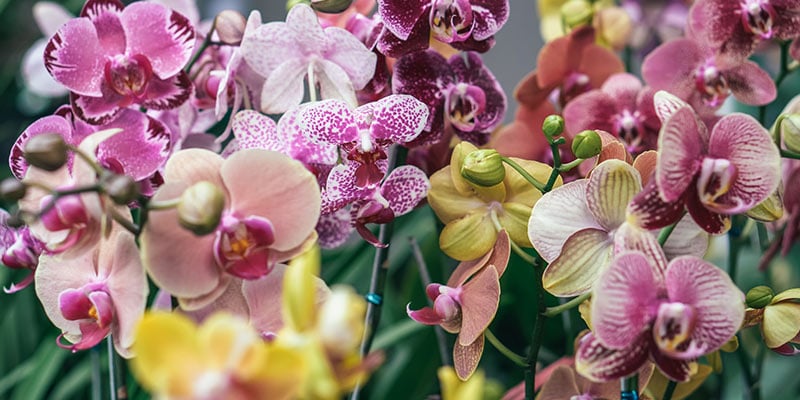
As a director, Baz Luhrmann is known for his maximalist aesthetic. For his 2013 adaptation of F. Scott Fitzgerald’s novel, The Great Gatsby, he used an explosion of florals as the backdrop to the eponymous Jay Gatsby’s (Leonardo DiCaprio) first reunion with his long-lost love, Daisy Buchanan (Carey Mulligan). In the scene, Gatsby waits nervously amidst a huge array of cymbidium, dendrobium and phalaenopsis orchids, with his friend, Nick Carraway (Tobey Maguire) mockingly asking him, “do you think we have enough flowers?” According to reports, the floral design was inspired by the British florist of the 1930s, Constance Spry, who was one of the most famous of the era in which Gatsby is set.
Last Tango in Paris, 1972
To say that Marlon Brando was one of the best actors of the 20th century would be an understatement. One of his most memorable performances came in 1972’s Last Tango in Paris, with the monologue that he delivers while looking at his dead wife Rosa in her casket being amongst the most moving. In it, Rosa is surrounded by hundreds of pink flowers, so many that Brando’s character Paul remarks that there are so many he cannot breathe. In contrast to this arrestingly beautiful sight comes the ugliness of Brando’s speech, in which he mockingly tells her, “I wish you could see yourself, you’d really laugh. You’re your mother’s mantlepiece,” before angrily using a handful of petals to scrub at the make-up on her face.
Memoirs of a Geisha, 2005
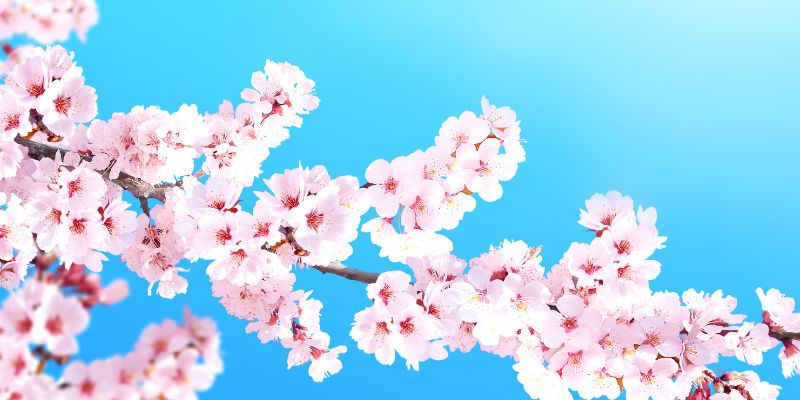
The Japanese cherry blossom, Sakura, plays an important role throughout 2005’s Memoirs of a Geisha. In the film, the pink flower is used to symbolise the fleeting nature of life, and how important it is to live in the now, with one of the pivotal scenes in the love story of Sayuri (Zhang Ziyi) and the Chairman (Ken Iwamura), taking place amongst them. In many ways, they are also used as a parallel to Sayuri’s life story, as she spends her time cultivating moments of beauty, only for them to fade away quickly. Her name, Sayuri, also means “small lily” in Japanese, another sign that flowers are integral to the plot.
Vertigo, 1958
Director Alfred Hitchcock was a skilled user of visual motifs and metaphors, so when he puts flowers in a scene, you know it’s significant. Such is the case with 1958’s Vertigo, which follows the story of a newly retired police detective (James Stewart) who is employed to follow Madeleine, (Kim Novak) a woman whose husband believes she is possessed. At the beginning of the film, we see Madeleine buying a beautiful bunch of flowers in a huge flower shop, with colourful blooms all around her, with the detective watching from the shadows. Later on, she rips the flowers apart, in a flash of desperation and hopelessness, with the bouquet shown to be a direct representation of her fragile, delicate character.
The Wizard of Oz, 1939
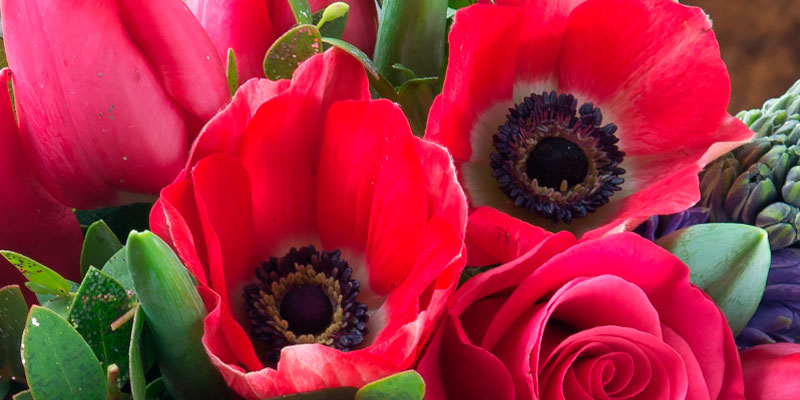
In The Wizard of Oz, The Wicked Witch of the West attempts to stop Dorothy and her motley crew from reaching the Emerald City by luring them to a meadow of bright red poppies, known in mythology and literature for inducing sleep. In the 1939 film, the poppy field becomes one of the most vibrant backdrops, with the image of Dorothy (Judy Garland) curled up amongst them instantly recognisable. Yet despite this beautiful and arresting image, there’s a darkness to it, as Dorothy and the Lion are both overcome by the pungent narcotic, falling asleep. It is only when Glinda the Good Witch sends snow that the pair wake up to continue their journey to meet the wizard.
Midsommar, 2019
The prettiness of flowers can sometimes be used in contrast to the ugliness of the plot, and such is the case in 2019 horror film, Midsommar. Set in a small and remote Swedish community, it follows a group of Americans who come to witness the tradition of midsummer. As such, flowers form an important part of the backdrop, as the community lives in the wild, and the summer sees some of the most colourful flowers bloom. Yet there is a darkness haunting the group, as this pagan ritual becomes murderous. In the final scene, Florence Pugh’s character Dani is crowned the May Queen, wearing a huge floral dress and headpiece, symbolic of her rebirth. It’s particularly striking because of the disconnect between the stunning prettiness of her outfit, and the horrors that have just taken place to see her take the throne.
To Catch A Thief, 1955
Hitchcock clearly had a thing about flower markets, because there’s also a scene in 1955’s To Catch A Thief that includes one. While the action is supposed to take place in the real life market of Cours Saleya, it was actually filmed on the nearby Boulevard Jean Jaurès, in order to have enough space for the film crew. A cacophony of rainbow hues, the scene is mostly memorable for involving main character, Cary Grant, in a dramatic chase that results in a fight with an old female market seller, who hits him again and again with a bunch of flowers.







 Loading...